

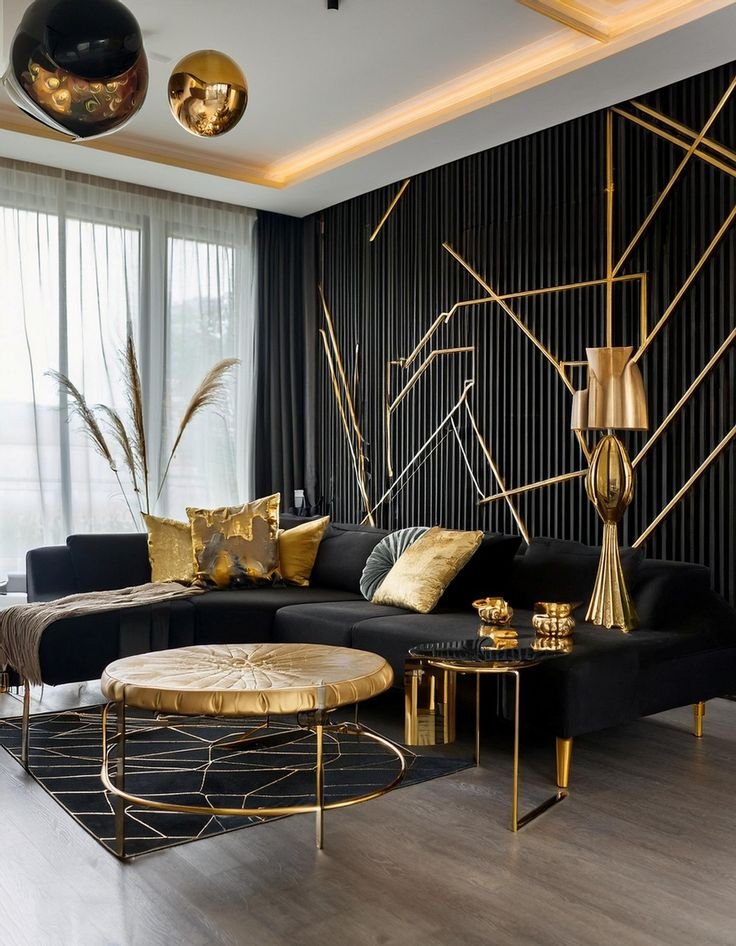

PVD coating has quietly become one of the most sought-after finishing choices in contemporary interior design. Whether it appears on a sculptural dining table, a custom console, or an architectural partition, the expectation is clear — the surface must look refined and stay that way. The growing demand for PVD Coated Furniture reflects a deeper shift in how designers and clients think about materials: not just how something looks on day one, but how it holds up through years of real use.
Yet the selection process is often rushed or oversimplified. Many decisions hinge on aesthetics alone, without a working understanding of how PVD coating actually behaves in practice. What makes this costly is simple — even the most advanced coating process cannot compensate for weak groundwork. At Backrock Evolution, this principle shapes every project. Because a technically superior finish applied to a poorly prepared surface is still a poor outcome.
Treating PVD Like Paint or Standard Plating
One of the most persistent misunderstandings is assuming PVD works like paint — applied on top, covering what's underneath. It does not. PVD creates a bonded metallic layer at a microscopic level. It does not mask what lies beneath. It amplifies it.
Minor surface flaws — faint scratches, inconsistent polishing, or residual weld marks — become far more visible once the coating is applied. In projects involving metal furniture in Ahmedabad, this realisation often arrives after installation, when light hits the surface at an angle and reveals what the workshop environment never made obvious.
Recognising how PVD behaves changes the entire preparation mindset. The emphasis moves from fixing to preventing.
Undervaluing the Role of Base Material
Most people assume the coating does the heavy lifting. In reality, the base material determines much of the outcome. Stainless steel is the standard choice for PVD applications — it offers a stable, corrosion-resistant foundation. But not all stainless steel performs equally.
Inconsistent or lower-grade material might reduce upfront costs, but it introduces variability in finish quality and long-term performance. The final product may look acceptable initially, yet deteriorate faster than expected.
In metal fabrication work in Ahmedabad, experienced manufacturers understand this early. Material selection isn't a visible choice — it doesn't show in photographs or showroom samples. But it directly shapes how the coating adheres, how it wears, and how long it retains its character.
Treating Surface Preparation as a Checkbox
Surface preparation is easy to underestimate. It sounds like a routine step — clean the metal, apply the coating. In practice, it is one of the most consequential stages in the entire process.
Polishing must be executed with consistent pressure and method, whether the target finish is mirror or satin. Skipping stages, rushing through passes, or applying uneven technique leaves behind subtle irregularities that the coating will faithfully preserve.
For PVD Coated Furniture placed in well-lit environments, these inconsistencies can alter how the entire piece reads. A surface that looks acceptable under workshop lighting may tell a different story beneath architectural spotlights or natural daylight.
Selecting Finishes in Isolation
Choosing a finish based on a sample or catalogue image is a common shortcut. The problem is that interiors are living environments — lighting shifts throughout the day, usage accumulates, and surrounding materials interact with how surfaces are perceived.
Mirror and high-gloss finishes have strong visual impact in controlled settings, but they also demand more ongoing attention. Fingerprints, smudges, and contact marks show readily, especially in high-touch areas. Brushed and matte options offer a quieter aesthetic with greater forgiveness in daily use.
A knowledgeable PVD Coating service provider in Ahmedabad accounts for these dynamics before recommending a finish. When that context is missing from the decision, what looked striking in a showroom may feel impractical six months into a project.
Assuming Color Consistency Happens Automatically
Gold, bronze, champagne, gunmetal — the colour choices feel straightforward. The consistency challenge is less obvious until multiple pieces arrive on-site and the differences become visible.
Variations in colour can result from subtle differences in surface preparation between batches, shifts in coating parameters, or inconsistencies in the pre-treatment process. When several components come together in a shared visual field, even modest inconsistencies fragment the overall impression.
Maintaining uniformity requires deliberate process control at every stage. Without it, individual pieces that each appear acceptable can fail to cohere as a complete installation.
Separating Fabrication from Finishing
PVD does not correct structural problems. It reveals them.
Misaligned joints, uneven welds, and inconsistent edges do not disappear beneath the coating — they become more pronounced. In minimalist interiors where clean lines are the entire visual language, fabrication flaws at this scale can undermine the whole design intent.
This is why metal fabrication work in Ahmedabad must be held to the same standard as the finishing process itself. They are not separate disciplines. Every decision made during fabrication directly shapes what the coating will eventually highlight.
Prioritising Cost Above Process
Budget considerations are unavoidable. The issue arises when cost becomes the dominant filter for choosing a coating provider, because that choice tends to invite compromises in ways that only become visible later.
PVD coating requires specialised chamber equipment, controlled atmospheric conditions, and experienced operators who understand process variables. A dependable PVD Coating service provider in Ahmedabad maintains these standards consistently. Cheaper alternatives may reduce cycle times, skip verification steps, or operate with less precision — and the results reflect that over time.
In high-end interiors, these differences surface gradually. What seemed economical at the project stage can lead to visible degradation, requiring refinishing or replacement sooner than planned.
Misjudging Maintenance Requirements
PVD coatings genuinely are lower maintenance than many alternatives. But lower maintenance is not zero maintenance.
Abrasive cleaning materials and aggressive chemical agents can degrade the surface over time. In most cases, a soft cloth and a mild cleaning solution are entirely sufficient. The priority is consistency — light, regular care rather than occasional intensive cleaning.
Clients investing in PVD Coated Furniture benefit from understanding these basics upfront. It is a small commitment that meaningfully extends the lifespan and appearance of the finish.
Allowing Gaps Between Design Intent and Execution
Many projects encounter problems not because of technical failures, but because of miscommunication. Designers specify a finish based on visual references. Fabricators interpret those references through production constraints. Coating specialists receive briefs that may lack sufficient detail about the intended outcome.
These gaps produce adjustments mid-process — and adjustments mid-process produce inconsistencies in the final result.
In projects involving metal furniture in Ahmedabad, particularly custom work, this coordination is not optional. Clear, ongoing communication between designers, fabricators, and coating teams is what keeps design intent intact from the initial sketch through to installation.
Ignoring How the Space Will Actually Be Used
A decorative element in a private residence lives a very different life than a fixture in a commercial setting. One may be touched occasionally; the other may be contacted hundreds of times each day.
Treating these contexts as equivalent when selecting a finish is a practical mistake. High-traffic environments call for finishes that resist visible wear under frequent contact. Even more decorative applications require durability — just expressed differently.
The right finish emerges from understanding how a piece will be used, not only how it will be photographed.
Compressing the Timeline
PVD coating is a multi-stage process — fabrication, polishing, pre-treatment cleaning, coating, and post-process inspection. Each stage has its own requirements. None of them benefit from being rushed.
When project timelines tighten, there is pressure to treat these stages as interchangeable or to compress what takes time. In practice, this leads to inconsistencies that inspection may not catch — but that become visible once the piece is installed and lit.
Planning adequate time for each stage is not a luxury. In custom work, it is the difference between a result that holds its quality and one that falls short of what the design intended.
A More Considered Approach
Selecting PVD coating is not simply a matter of choosing a colour and a sheen level. It is a decision that extends backward through material selection and fabrication quality, and forward through maintenance and long-term performance.
At Backrock Evolution, these stages are understood as a unified process rather than separate tasks. That perspective is what allows for results that are both visually consistent and structurally dependable.
As demand for PVD Coated Furniture continues to grow, the projects that stand apart will be those built on informed decisions at every stage — not just the final one.