

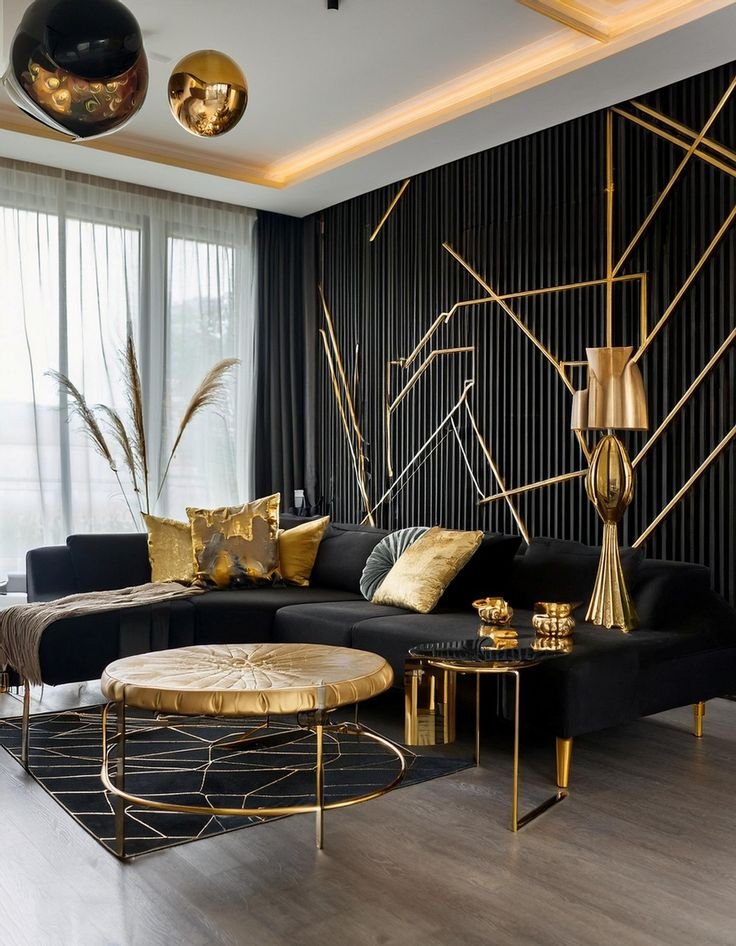

Surface finishes in luxury interiors have always reflected the era they belong to. Marble defined classical opulence. Lacquered wood carried mid-century refinement. Today, Physical Vapor Deposition — known in the industry as PVD coating — is quietly becoming the finish that defines contemporary luxury. Not because it follows a trend, but because it solves problems that traditional finishes never could.
At Backrock Evolution, this shift is visible across every category of work — from custom PVD coated furniture to architectural metal elements in premium residential and commercial projects. The reasons designers and architects keep returning to PVD are not superficial. They are rooted in how the finish actually performs, ages, and integrates with serious design intent.
Here are seven reasons why PVD coating is now central to the language of modern luxury interiors.
1. A Surface That Holds Its Ground Over Years, Not Months
Most conventional finishes compromise under pressure. Paint chips. Electroplated surfaces tarnish. Powder coating scratches. PVD coating behaves differently because it bonds at a molecular level with the base metal, creating a surface that is genuinely harder and more resistant than what sits beneath it.
In luxury interiors — particularly in high-use environments like hotel lobbies, corporate reception areas, and active dining spaces — surfaces absorb a significant amount of daily contact. The expectation in these settings is that quality should remain visible, not just promised. PVD-coated surfaces meet that expectation consistently.
For metal furniture in Ahmedabad specifically, where humidity, temperature variation, and coastal air in nearby regions can accelerate surface degradation, a PVD finish offers protection that painted or plated alternatives simply cannot sustain at the same level over time.
2. Metallic Finishes That Do More Than Look Good
There is a visual quality to PVD-coated surfaces that is difficult to achieve through other methods. Champagne gold, black titanium, brushed bronze, rose gold, gunmetal — each finish produced through PVD has a depth and consistency that catches light in a way that feels material rather than applied.
This matters in interior design because surfaces don't exist in isolation. They interact with lighting, with adjacent materials, and with the spatial experience as a whole. A flat, uniform gold from electroplating reads as decoration. A well-executed PVD gold reads as material — it feels like part of the object rather than a layer on top of it.
Designers specifying PVD coated furniture across a project benefit from this consistency. The same finish applied to a dining table base, a partition frame, and a reception desk creates visual coherence that holds the design together without looking repetitive.
3. Precision Fabrication and Surface Finishing, Working Together
Modern luxury design increasingly favors clean geometry — sharp edges, minimal joints, forms that communicate clarity of intent. Achieving this requires precision at the fabrication stage and a finish that doesn't compromise what the fabrication created.
The growing demand for metal fabrication work in Ahmedabad reflects how central custom metalwork has become to serious interior projects. Laser-cut panels, CNC-bent profiles, and TIG-welded frames are now standard in premium furniture and architectural detailing. When these components are finished with PVD coating, the surface enhances rather than obscures what the fabrication achieved.
Edges remain defined. Surfaces are smooth without being plastic. The overall result looks engineered and considered — which is precisely what high-end design clients expect when they commission custom work.
4. Low Maintenance That Respects the Value of the Space
A luxury interior is an investment. Its value depends not just on how it looks when completed, but on how it continues to look a year, three years, five years later. Finishes that require frequent touch-ups, refinishing, or careful handling introduce friction into how a space is actually used and maintained.
PVD-coated surfaces are resistant to staining, oxidation, and the kind of surface wear that gradually degrades the appearance of painted or plated metals. Routine cleaning is typically all that is needed. There are no periodic refinishing requirements and no need to manage the surface with special products.
For property owners, hospitality operators, and commercial clients, this translates directly into lower long-term maintenance costs and a space that continues to represent its intended quality without ongoing intervention.
5. One Finish Language Across an Entire Space
Design coherence in a luxury interior comes from continuity — materials and finishes that relate to each other across different elements and functions. PVD coating makes this possible at a practical level because it can be applied across a wide range of components: furniture frames, wall panels, door hardware, railings, lighting fixtures, decorative screens, and partition systems.
This means a single finish can run consistently through an entire project. The same black titanium that appears on the dining table base can reappear on the staircase railing, the reception desk edge trim, and the bathroom hardware — creating a thread of material continuity that reads as intentional and resolved.
In projects where metal furniture in Ahmedabad is being integrated with broader architectural metalwork, this ability to maintain finish consistency across fabricated components from different categories is a practical advantage that few other finishing methods can offer.
6. The Finish Communicates Quality Before Anyone Explains It
In commercial luxury environments — hospitality, corporate offices, premium retail — first impressions carry significant weight. The materials and finishes in a space communicate something to every person who enters it, usually before they consciously register what they're looking at.
PVD-coated surfaces read as quality. Their consistency, smoothness, and resistance to the kind of wear that makes cheaper finishes look tired quickly all contribute to an impression of permanence and care. For brands and businesses, that impression is part of what they are communicating to clients, guests, and partners who experience their space.
Backrock Evolution approaches PVD finishing with this in mind — not as a decorative layer applied at the end of the process, but as a considered part of how each piece contributes to the identity and atmosphere of the space it will inhabit.
7. A Longer Life Cycle That Aligns With Responsible Design
The most sustainable material choice is usually the one that lasts the longest. Components that hold their quality over extended periods reduce the frequency of replacement, which reduces material consumption, manufacturing energy, and waste over the lifetime of a project.
PVD coating extends the functional and aesthetic life of metal components meaningfully. Combined with stainless steel — which is itself fully recyclable — PVD-finished furniture and architectural elements represent a genuinely responsible long-term choice for clients who think about the full lifecycle of what they invest in.
This matters increasingly to modern clients in both residential and commercial sectors, who expect premium design to reflect considered values, not just premium pricing.
Execution Is What Separates Good Results From Exceptional Ones
The advantages of PVD coating are real, but they are only fully realized when the process is executed properly. Surface preparation before coating is critical — any inconsistency in polishing or cleaning carries through to the final finish. Process control during coating determines uniformity. Post-process inspection determines whether the piece actually meets the standard it was designed to.
Working with a reliable PVD coating service provider in Ahmedabad means these variables are managed rather than left to chance. At Backrock Evolution, fabrication and finishing are treated as a continuous process, not separate stages handed off between teams. The same standards that govern how a piece is cut and welded govern how it is finished — because the quality of one depends entirely on the quality of the other.
What This Shift Actually Means for Luxury Interiors
The growing role of PVD coating in luxury design is not a styling preference. It reflects a more fundamental change in how serious designers and clients think about materials — not just in terms of appearance but in terms of performance, longevity, and how well a finish holds up against the reality of how spaces are actually used.
PVD coated furniture is not a category that appeared because of a mood board or a passing trend. It exists because the combination of visual quality, surface durability, and design versatility it offers is genuinely difficult to match through other means.
In Ahmedabad, where architectural ambition and interior design standards are rising across both residential and commercial sectors, this material shift is already visible in the projects that set the benchmark. Backrock Evolution is at the center of that shift — combining precision metal fabrication with advanced surface finishing to produce work that meets the expectations of contemporary luxury and outlasts the projects built around it.